
}})
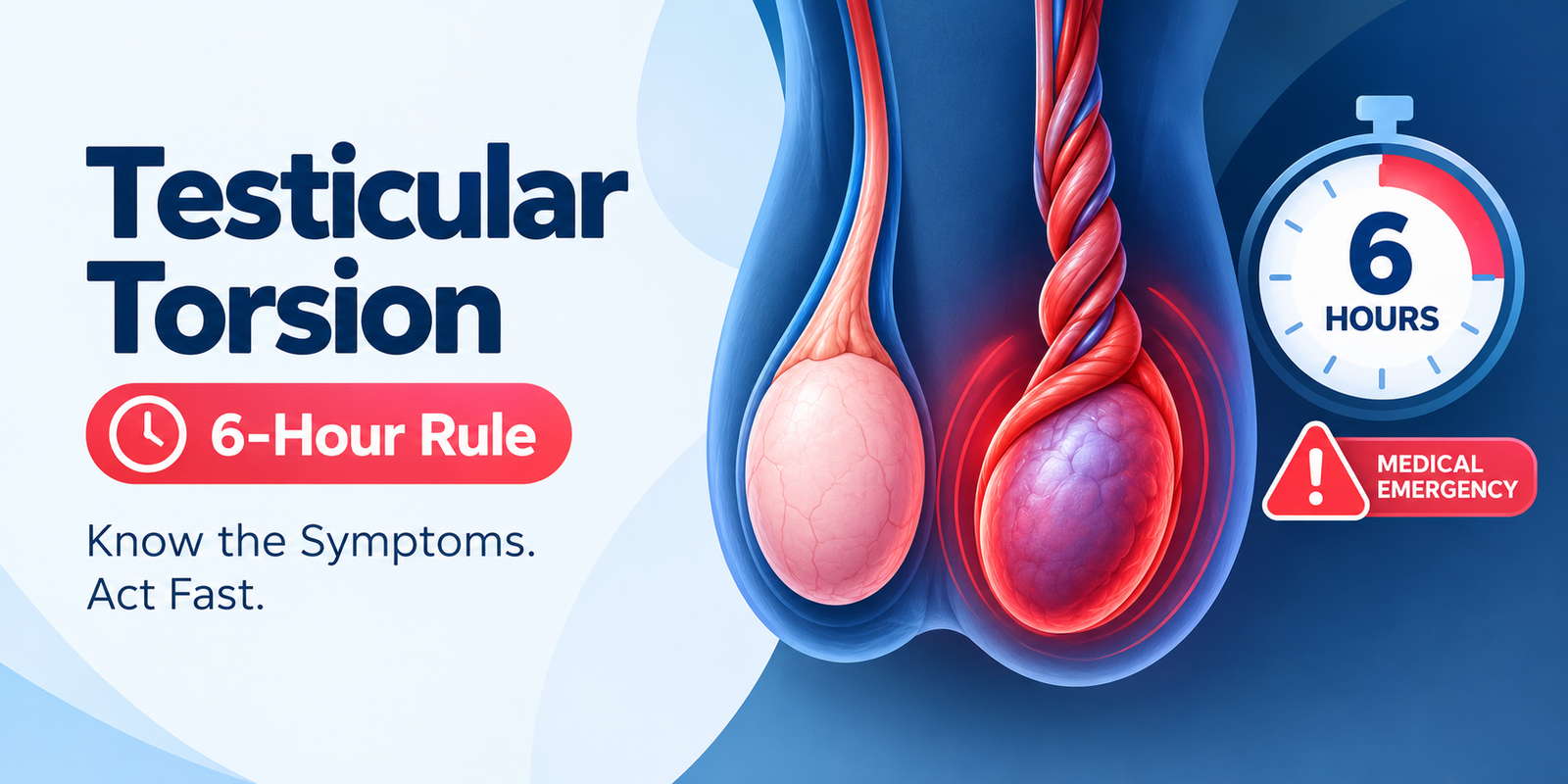
Quick answer: Testicular torsion is a medical emergency where the spermatic cord twists and cuts off the blood supply to the testicle. It causes sudden, severe pain in one testicle, often with nausea, vomiting, and scrotal swelling. The testicle can only be saved if surgery is performed within 6 hours. After 24 hours, salvage is very unlikely. Any man with sudden, severe testicle pain must go to the emergency room immediately. Testicular torsion is most common in boys aged 12 to 18 but can occur at any age.
Testicular Torsion at a Glance
- What it is: twisting of the spermatic cord that cuts off blood supply to the testicle
- Severity: true surgical emergency
- Golden window: within 6 hours for near-full salvage
- Main symptom: sudden, severe one-sided testicle pain
- Peak age: 12 to 18 years, though can occur at any age
- Treatment: emergency surgery (orchidopexy)
- Delay cost: every hour reduces the chance of saving the testicle
What is Testicular Torsion?
Testicular torsion is a condition in which the spermatic cord twists on itself, cutting off blood flow to the testicle. The spermatic cord carries the arteries, veins, and nerves that supply the testicle. When it twists, the blood supply is strangled, and the testicle begins to die within hours.
Testicular torsion is one of the few true surgical emergencies in urology. It is not a condition to monitor, wait out, or treat with painkillers. Without rapid treatment, the affected testicle can be permanently lost.
Why Testicular Torsion Is a Medical Emergency: The 6-Hour Rule
Testicular torsion is a medical emergency because the testicle starts to die once blood flow is cut off, and salvage depends almost entirely on how quickly surgery is performed. The timeline below is why this condition is often called a "race against the clock."
Testicular Salvage Rate by Time to Surgery
| Time from pain onset to surgery | Chance of saving the testicle |
|---|---|
| Within 6 hours | 90 to 100 percent |
| 6 to 12 hours | Around 50 percent |
| 12 to 24 hours | Around 20 percent |
| More than 24 hours | Less than 10 percent |
The six-hour window is sometimes called the golden window. Every hour of delay significantly reduces the chance of saving the testicle. This is why sudden severe testicular pain is never something to sleep off, wait out, or try to manage at home.
What Are the Symptoms of Testicular Torsion?
Testicular torsion typically causes sudden, severe pain in one testicle along with scrotal swelling, nausea, and vomiting. The pain often starts without warning, sometimes waking a boy or man from sleep.
Common symptoms of testicular torsion:
- Sudden, severe pain in one testicle (usually one-sided)
- Scrotal swelling on the affected side
- A testicle that sits higher than usual or looks abnormally positioned
- Nausea and vomiting
- Lower abdominal or groin pain
- Redness or darkening of the scrotal skin
- Pain that does not ease with position changes or rest
Pain from torsion is typically severe, constant, and worsens over the first few hours. It is not usually described as an ache. If pain is mild or comes and goes, another cause is more likely, but torsion can still not be ruled out without examination.
For a broader look at scrotal pain patterns, see our guide on why do my testicles hurt.
What Causes Testicular Torsion?
Testicular torsion is usually caused by an anatomical variant that lets the testicle rotate too freely inside the scrotum. The main causes are:
- Bell clapper deformity (most common): the testicle is not properly anchored to the scrotal wall and hangs freely like the clapper of a bell, letting it rotate
- Trauma or injury to the groin or scrotum
- Vigorous activity, sport, or heavy exertion
- Rapid growth during puberty, which can trigger first episodes
- Cold temperatures causing scrotal muscles to contract
- Sleep, during which many episodes occur spontaneously
- A previous torsion on the other side (significantly raises risk)
In many cases, torsion happens with no obvious trigger at all.
Who is Most at Risk?
Testicular torsion is most common in adolescent boys aged 12 to 18, but it can occur at any age, including infants and adults. The two age peaks are:
- Newborn and infant males (perinatal torsion)
- Adolescents aged 12 to 18, the single highest-risk group
Risk factors include:
- Age 12 to 18
- A history of brief, self-resolving testicle pain (possible intermittent torsion)
- Family history of torsion
- Bell clapper deformity
- Undescended testicle
- Previous torsion on the other side
Testicular Torsion vs Epididymitis: How to Tell the Difference
Testicular torsion and epididymitis can look similar, but torsion is an emergency and epididymitis is not. Telling them apart matters, though a definitive diagnosis always requires medical evaluation.
| Feature | Testicular Torsion | Epididymitis |
|---|---|---|
| Pain onset | Sudden, severe | Gradual, builds over hours to days |
| Age most affected | 12 to 18 | Any adult age |
| Nausea or vomiting | Common | Uncommon |
| Fever | Rare | Common |
| Burning urination | No | Often yes |
| Discharge | No | Sometimes |
| Testicle position | Often higher than usual | Normal position |
| Response to lifting the testicle | Pain often worse | Pain often better |
| Scrotal ultrasound | No blood flow to testicle | Increased blood flow |
| Urgency | Surgical emergency | Treated with antibiotics |
Rule of thumb: sudden severe pain in a young man with no urinary symptoms and no fever should be treated as torsion until proven otherwise.
What is Intermittent Testicular Torsion?
Intermittent testicular torsion is a condition where the testicle twists briefly and untwists on its own, causing short episodes of severe pain that resolve without treatment. Each episode usually lasts minutes to a few hours.
Men with intermittent torsion often describe:
- Repeated episodes of sudden one-sided testicle pain
- Pain that fully resolves between episodes
- No fever, discharge, or urinary symptoms
- Episodes often triggered by exercise, movement, or sleep
Intermittent torsion is important because it tends to progress to full torsion over time. Any man with recurrent brief episodes of sudden testicle pain should see a urologist for evaluation and often preventive surgery (orchidopexy on both sides).
How is Testicular Torsion Diagnosed?
Testicular torsion is diagnosed clinically on examination, confirmed by a scrotal Doppler ultrasound, which shows absent or reduced blood flow to the testicle. The usual workup is:
- Immediate clinical examination by a urologist or emergency physician
- Scrotal Doppler ultrasound to check blood flow to both testicles
- Urinalysis to help rule out epididymitis or infection
- Blood tests if infection is being considered
If the diagnosis is clinically obvious, surgery should not be delayed waiting for imaging. In emergency practice, time is more important than confirmation.
How is Testicular Torsion Treated?
Testicular torsion is treated with emergency surgery (orchidopexy) to untwist the cord and anchor both testicles so it cannot recur. The procedure has three main steps:
- Detorsion: the surgeon untwists the spermatic cord to restore blood flow
- Assessment: the testicle is checked to see if it is viable
- Orchiopexy: the testicle is anchored to the scrotal wall with stitches, and the other side is usually fixed at the same time to prevent torsion there
If the testicle is already dead or beyond salvage, it is removed (orchiectomy). The remaining testicle continues to produce testosterone and sperm, so fertility and hormone function are usually preserved.
Manual detorsion can sometimes be attempted in the emergency room as a temporary measure, but surgery is still required to prevent recurrence.
What is Recovery Like After Surgery?
Most men recover from torsion surgery within 2 to 4 weeks, with return to light activity within days and full activity after a few weeks. Typical recovery milestones:
- Days 1 to 3: rest, scrotal support, and pain relief
- Week 1: gentle activity, no heavy lifting, avoid sex and strenuous exercise
- Weeks 2 to 4: gradual return to normal activity
- Weeks 4 to 6: cleared for sport and vigorous exercise after review
Mild bruising, swelling, and tenderness are normal in the first week. Fever, worsening pain, redness, or discharge from the wound needs same-day review.
Can Testicular Torsion Happen Again?
No, torsion cannot happen again on the same side once the testicle has been anchored with orchidopexy. However, the opposite testicle is at increased risk, which is why surgeons usually fix both sides during the first surgery.
If orchidopexy was not performed, or if symptoms return on either side, immediate medical attention is required.
When to Go to the Emergency Room
Go to the emergency room immediately for sudden, severe one-sided testicle pain, especially with nausea, vomiting, or scrotal swelling. Do not wait, do not call a clinic, do not try pain relief at home.
Go to the ER right away if you have:
- Sudden, severe testicle pain
- Scrotal swelling with pain
- Nausea or vomiting with testicle pain
- A testicle sitting higher than usual
- Pain after minor trauma that does not settle in minutes
- Recurrent brief episodes of severe testicle pain (possible intermittent torsion)
If swelling without severe pain is the main concern, see our guide on why one of my testicles is swollen for the broader differential.
Expert Care for Testicular Torsion and Emergency Urology in Delhi NCR
Testicular torsion is one of the few surgical emergencies where every hour counts. Prompt expert evaluation can mean the difference between saving and losing the testicle.
Dr. Ashish Saini is a urologist and andrologist at Excel Advanced Urology Center in Greater Kailash 1, New Delhi, whose practice covers the full spectrum of male urological and reproductive emergencies.
- MCh Urology from AIIMS, New Delhi
- MBBS and MS from KGMU, Lucknow
- 15+ years of clinical experience in urology and andrology
- 21,000+ surgeries performed across urological procedures
This depth of training means torsion is recognised quickly, surgery is performed within the golden window where possible, and both testicles are protected against future torsion.