
}})
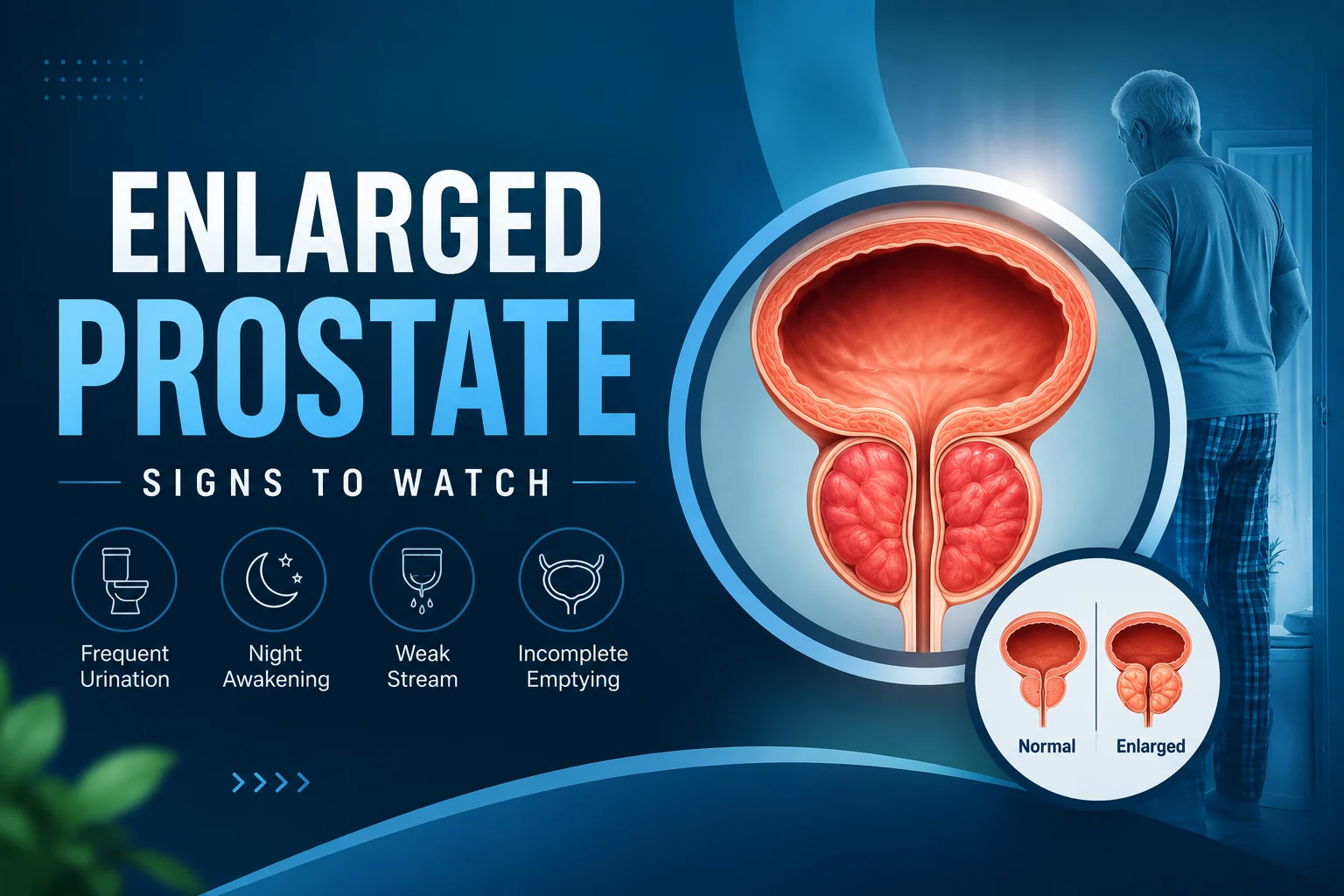
The most common symptoms of an enlarged prostate are a weak urine stream, difficulty starting urination, frequent urination, especially at night, a sudden, urgent need to go, and a feeling that the bladder never empties fully. These usually develop slowly with age. An enlarged prostate is not cancer, but symptoms can worsen over time, so it is worth getting checked if they affect your sleep or daily life.
Many men notice small changes in the way they urinate as they get older. A stream that is weaker than it used to be, more trips to the bathroom at night, or a sense that the bladder is never quite empty. It is easy to brush these off as a normal part of ageing, but they are often the first signs of an enlarged prostate. Recognising them early makes the condition far easier to manage. This guide explains every major symptom, how the condition progresses, and when it is time to see a doctor.
What is an Enlarged Prostate (BPH)?

The prostate is a small, walnut-sized gland that sits below the bladder and wraps around the urethra, the tube that carries urine out of the body. As men age, the prostate naturally grows. When it grows large enough to press on the urethra, it narrows the channel and forces the bladder to work harder. Doctors call this benign prostatic hyperplasia, or BPH. The word benign is important: this is a non-cancerous condition, and it does not increase your risk of prostate cancer.
The Main Symptoms of an Enlarged Prostate
BPH symptoms fall into two groups, and most men experience a mix of both.
Obstructive Symptoms
These are caused by the prostate squeezing the urethra and blocking flow:
- A weak or slow urine stream
- Difficulty starting urination, known as hesitancy
- Having to strain or push to pass urine
- A stream that stops and starts
- Dribbling at the end of urination
- A feeling that the bladder has not fully emptied
Storage Symptoms
These come from the bladder becoming irritated and overworked:
- Needing to urinate often, sometimes every one to two hours
- Waking more than once at night to urinate is known as nocturia
- A sudden, strong urge that is hard to postpone
- Occasional leakage when the urge strikes
Early Warning Signs Every Man Should Know
If you are wondering whether your symptoms point to an enlarged prostate, five early signs are worth paying attention to:
- Taking longer than usual to start urinating
- A noticeably weaker stream
- Needing to urinate far more often than before
- A sudden, urgent need to go
- Waking at night to empty your bladder
These signs usually appear gradually, which is exactly why they are so easy to overlook. Noticing them early gives you the best chance of simple, effective treatment.
Understanding Specific Symptoms
Some symptoms deserve a closer look, because they can point to how advanced the condition is or whether another problem is involved.
Waking at Night to Urinate (Nocturia)
One of the most disruptive symptoms is nocturia, waking one or more times each night to urinate. It fragments sleep and leaves many men tired during the day. Frequent nighttime urination is often one of the earliest and most bothersome signs of BPH.
Blood in the Urine (Hematuria)
Enlarged prostate tissue has fragile blood vessels that can sometimes bleed, leading to blood in the urine. While BPH is a common cause, blood in the urine should always be evaluated by a doctor to rule out other conditions.
Burning or Painful Urination (Dysuria)
BPH does not usually cause pain by itself. When burning or discomfort appears during urination, it often signals a urinary tract infection, a complication that can develop when the bladder cannot empty properly.
Cloudy Urine
Urine that looks cloudy can be a sign of infection or of urine sitting too long in a bladder that is not emptying fully. It is a symptom worth mentioning at your consultation rather than ignoring.
How Symptoms Progress: The Stages of BPH

BPH tends to move through broad stages, though the pace varies from man to man.
- Mild: Symptoms are subtle and only occasionally noticeable. Many men manage well with small lifestyle changes.
- Moderate: Symptoms become a daily nuisance, affecting sleep, work, and confidence. This is the stage at which most men seek treatment.
- Severe: Flow is badly restricted, the bladder struggles to empty, and complications such as infections or retention become more likely.
The important point is that BPH rarely improves on its own. Left unchecked, it usually progresses, which is why early attention matters.
What Causes These Symptoms and Who Is at Risk
The exact trigger for prostate growth is not fully understood, but hormones play a central role. As men age, changes in testosterone and the hormone dihydrotestosterone (DHT) encourage prostate cells to multiply. Several factors raise your risk:
- Age: The single biggest factor. Growth often begins around 40, and most men over 60 show some signs.
- Family history: Having a father or brother with BPH increases your risk.
- Lifestyle and health: Obesity, type 2 diabetes, and a lack of physical activity are linked to a higher chance of BPH.
Enlarged Prostate vs Prostate Cancer: Clearing the Confusion
This is one of the biggest worries men have, so it is worth being clear. An enlarged prostate is not cancer, and having BPH does not make prostate cancer more likely. The two are separate conditions. The reason they confuse is that they can share urinary symptoms and both can raise PSA levels on a blood test. Because of this overlap, a proper evaluation is the only reliable way to tell them apart. Getting checked is not a cause for alarm; it is simply the sensible way to rule anything else out.
When to See a Doctor
You should see a doctor if urinary symptoms are becoming more frequent, getting worse, or interfering with your sleep and daily routine. Symptoms rarely resolve by themselves, and early treatment is simpler and more effective.
Some symptoms need urgent medical attention. Seek help right away if you:
- Cannot urinate at all
- See blood in your urine
- Have a fever with pain or burning while urinating
- Feel severe pain in your lower abdomen
These can signal a complication, such as a complete blockage or infection that should not wait.
How an Enlarged Prostate Is Diagnosed
Diagnosing BPH is straightforward and painless. A urologist will usually:
- Ask you to rate your symptoms, often using a simple symptom score
- Perform a digital rectal exam to feel the size of the prostate
- Order a PSA blood test and a urine test
- Sometimes, add a urine flow test or an ultrasound to see how well the bladder empties
Together, these build a clear picture of what is causing your symptoms and how best to treat them.
Treatment Options at a Glance
The good news is that an enlarged prostate is very treatable, and surgery is rarely the first step. Mild cases often respond to lifestyle changes and medication. When these are not enough, a range of minimally invasive options can relieve the blockage with little downtime, including UroLift, Rezum, and iTind. For larger prostates or more severe symptoms, tissue-removing procedures such as TURP and HoLEP offer stronger, lasting relief. You can explore the full range on our prostate disease treatment page.
Expert Care for Enlarged Prostate in Delhi NCR
Understanding your symptoms is the first step. Getting them assessed by an experienced specialist is the next step. Dr. Ashish Saini is a urologist and andrologist at Excel Advanced Urology Center in Greater Kailash 1, New Delhi, who has spent his career treating prostate and urinary conditions.
- MCh Urology from AIIMS, New Delhi
- MBBS and MS from KGMU, Lucknow
- 15+ years of clinical experience in urology and andrology
- 21,000+ surgeries performed across urological procedures
This depth of training means your symptoms are properly evaluated, with the right tests and an honest discussion about whether lifestyle changes, medication, or a procedure is the best path for you.
If frequent urination, a weak stream, or broken sleep is affecting your quality of life, you do not have to simply live with it. Book an online consultation to understand what is causing your symptoms and how to fix them.