}})
UroLift, TURP, and HoLEP all relieve an enlarged prostate, but they work differently and suit different men. UroLift lifts the prostate lobes aside without cutting, offering the fastest recovery and best preservation of ejaculation, ideal for smaller prostates. TURP removes obstructing tissue and remains the proven gold standard for moderate enlargement. HoLEP uses a laser to remove the most tissue, making it the strongest and most durable choice for large prostates. The right one depends on your prostate size, symptom severity, and personal priorities.
As men grow older, urinary symptoms like a weak stream, difficulty starting, and waking repeatedly at night become common. These usually point to an enlarged prostate, known medically as benign prostatic hyperplasia or BPH. When medication is no longer enough, three procedures dominate the conversation in 2026: UroLift, TURP, and HoLEP. This guide compares them in depth so you can walk into your consultation already knowing the right questions to ask.
Understanding an Enlarged Prostate (BPH)
The prostate sits just below the bladder and wraps around the urethra, the tube that carries urine out of the body. As the gland enlarges, it squeezes the urethra and narrows the channel, a problem doctors call bladder outlet obstruction.
This leads to familiar lower urinary tract symptoms: a weak or interrupted stream, frequent urination especially at night, urgency, hesitancy, and a feeling that the bladder never empties fully. BPH is not cancer, and mild cases are often managed with lifestyle changes and medication such as alpha-blockers. When tablets stop working, when the bladder starts to suffer, or when urine flow is badly restricted, a procedure that physically relieves the blockage becomes the sensible next step.
The Three Procedures at a Glance
Although all three aim to reopen the urinary channel, they take very different routes to get there.
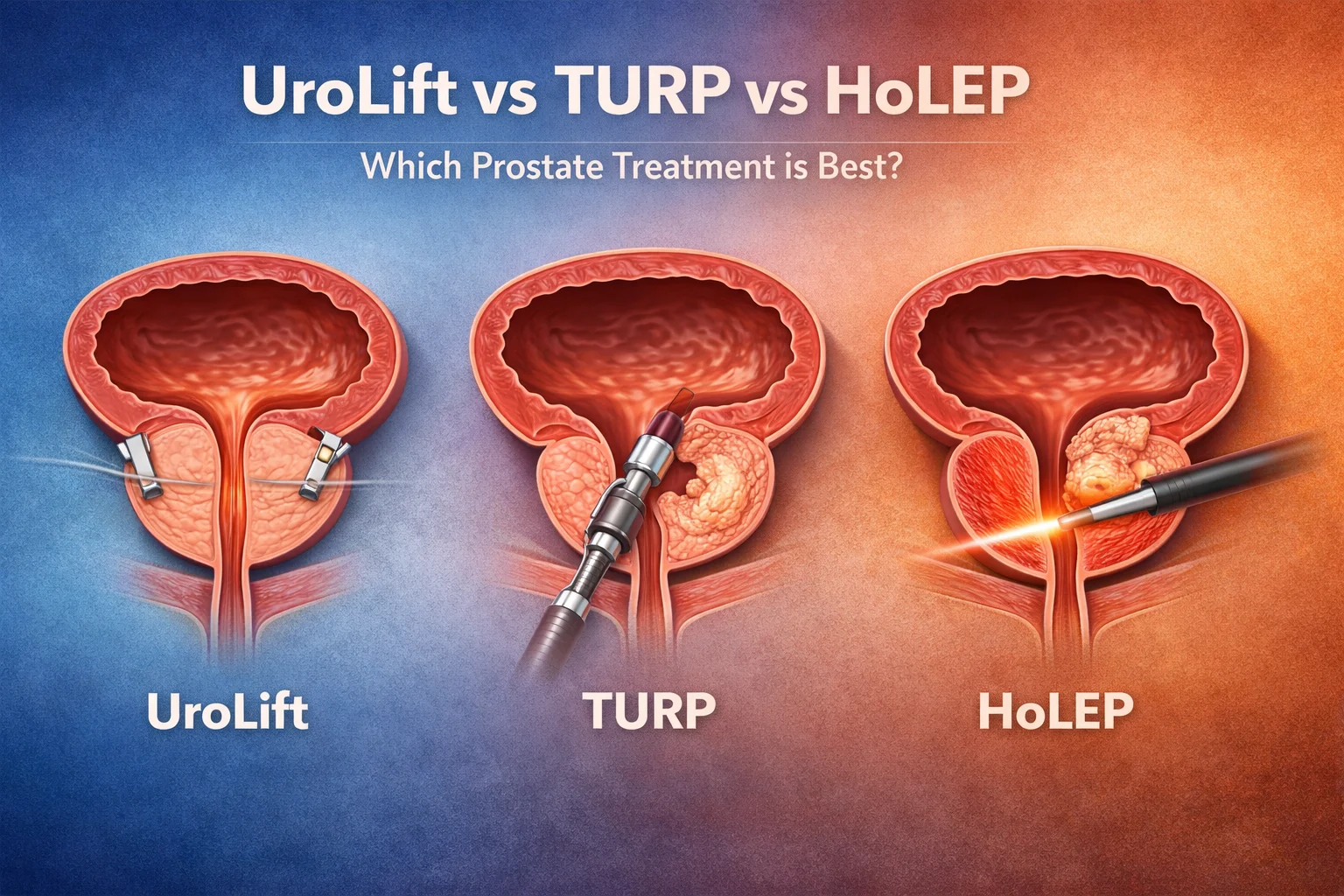
- UroLift is the least invasive. Rather than removing tissue, the surgeon places tiny permanent implants that hold the enlarged prostate lobes apart, widening the passage. No cutting, no heat, no tissue removed.
- TURP, or transurethral resection of the prostate, has been the benchmark BPH surgery for decades. Using an instrument with an electric loop passed through the urethra, the surgeon shaves away the obstructing tissue piece by piece.
- HoLEP, or holmium laser enucleation of the prostate, is a modern laser technique. A laser separates the entire enlarged inner tissue from the prostate capsule, which is then removed, clearing even very large glands.
A simple way to picture it: imagine clearing a blocked tunnel. UroLift pushes the walls apart, TURP scrapes pieces off the walls, and HoLEP removes the whole blocking section in one go.
UroLift vs TURP vs HoLEP: Comparison Table
The table below sums up the practical differences patients ask about most.
Effectiveness and Symptom Relief
The whole point of any prostate procedure is to restore flow and empty the bladder properly.
TURP has long been the gold standard, with decades of evidence showing reliable improvement in urine flow, often up to 90 percent. HoLEP matches or exceeds that, and its real strength is size: because it removes the most tissue, it delivers powerful relief even for glands too large for TURP. UroLift improves symptoms more modestly, around 30 percent, which is meaningful for many men but less dramatic than the tissue-removing options. In return, UroLift offers a gentler experience, which is why it appeals to men with milder symptoms who want to avoid surgery.
Recovery, Catheter, and Hospital Stay
This is where the three procedures feel most different day to day.
UroLift is usually an outpatient procedure. Most men go home the same day, often without a catheter, and return to light activity within a few days. TURP is more involved, typically needing a two to three-day hospital stay and a catheter for one to three days, with a few weeks of recovery as the temporary urgency or mild burning settles. HoLEP sits between the two in recovery, often with a shorter catheter time and less bleeding than TURP, thanks to the precision of the laser, though it still involves a short hospital stay. Across all three, doctors advise avoiding heavy lifting and strenuous activity in the early healing period.
Impact on Sexual Function
For many men, this is the deciding factor. All three procedures generally preserve erectile function. The difference lies in ejaculation.
UroLift preserves normal ejaculation in the large majority of men, with retrograde ejaculation in only 2 to 4 percent, because nothing is cut near the ejaculatory pathways. TURP causes retrograde ejaculation far more often, in roughly 65 to 75 percent of men, where semen travels backwards into the bladder during orgasm. HoLEP also commonly causes retrograde ejaculation. This is harmless to health and does not reduce pleasure, but it can affect fertility, which is why men who want to preserve ejaculation often lean toward UroLift.
Matching the Procedure to Prostate Size
Prostate size does much of the deciding, and imaging is used to measure it before any recommendation.
- Small to moderate prostates are well suited to UroLift, especially when symptoms are mild to moderate.
- Moderate prostates are a classic fit for TURP, one of the most widely performed and trusted procedures in the world.
- Large and very large prostates are best treated with HoLEP, which can clear glands far bigger than those TURP typically manages, and can even remove bladder stones in the same sitting.
A large median lobe or severe obstruction generally rules UroLift out and points toward a tissue-removing option.
Durability and Long-Term Results
How long the relief lasts is a genuine point of difference. UroLift relieves symptoms well but may need a repeat procedure over time, since the prostate keeps growing, and no tissue was removed. TURP offers durable results proven over decades. HoLEP is often the most durable of all, with the lowest long-term reoperation rate, because it removes the greatest volume of obstructing tissue. In short, you are weighing a gentler procedure against longer-lasting relief.
Where iTind and Rezum Fit In
UroLift, TURP, and HoLEP are not the only options. Two other minimally invasive treatments sit alongside UroLift at the gentler end of the spectrum. iTind uses a temporary device that reshapes the urinary channel over five to seven days and is then removed, leaving nothing behind. Rezum uses water vapour to shrink excess tissue over several weeks. If you are weighing the gentler options against each other, our iTind vs UroLift comparison is a useful next read, and you can see the full range on our prostate disease treatment page.
Cost in India
Cost in India depends on the procedure, the hospital, the surgeon, and the technology involved. As a broad guide, TURP is usually the most affordable because it uses conventional instruments, often falling in the region of Rs 90,000 to Rs 1,50,000. UroLift tends to sit higher, roughly Rs 1,50,000 to Rs 3,50,000, because of the cost of the implants. HoLEP generally ranges from about Rs 1,50,000 to Rs 3,00,000, reflecting the laser equipment and specialised training it requires. These are indicative ranges only. The most reliable figure always comes from a personalised consultation, where your prostate size and overall health are taken into account.
How the Right Procedure Is Chosen
There is no single treatment that is best for everyone. A specialist weighs prostate size first, then symptom severity, then your personal priorities. Some men value the fastest recovery and preserved ejaculation and lean toward UroLift. Others want the most powerful, lasting relief and are better served by TURP or HoLEP. Two men with identical symptoms can need very different procedures once size, anatomy, and goals are considered, which is exactly why a careful evaluation matters more than any single ranking.
Expert Care for Enlarged Prostate in Delhi NCR
When a decision spans this many options, experience is what turns a confusing choice into a clear one. Dr. Ashish Saini is a urologist and andrologist at Excel Advanced Urology Center in Greater Kailash 1, New Delhi, who has spent his career treating the full range of prostate and urinary conditions.
- MCh Urology from AIIMS, New Delhi
- MBBS and MS from KGMU, Lucknow
- 15+ years of clinical experience in urology and andrology
- 21,000+ surgeries performed across urological procedures
This depth of training means your enlarged prostate is assessed properly, with the right tests and an honest discussion about whether UroLift, TURP, HoLEP, or another approach truly fits you, rather than a one-size-fits-all recommendation.
If your symptoms are disturbing your sleep, your confidence, or your daily routine, you do not have to simply live with them. Book an online consultation to find out which option is the best path forward for you.