
}})
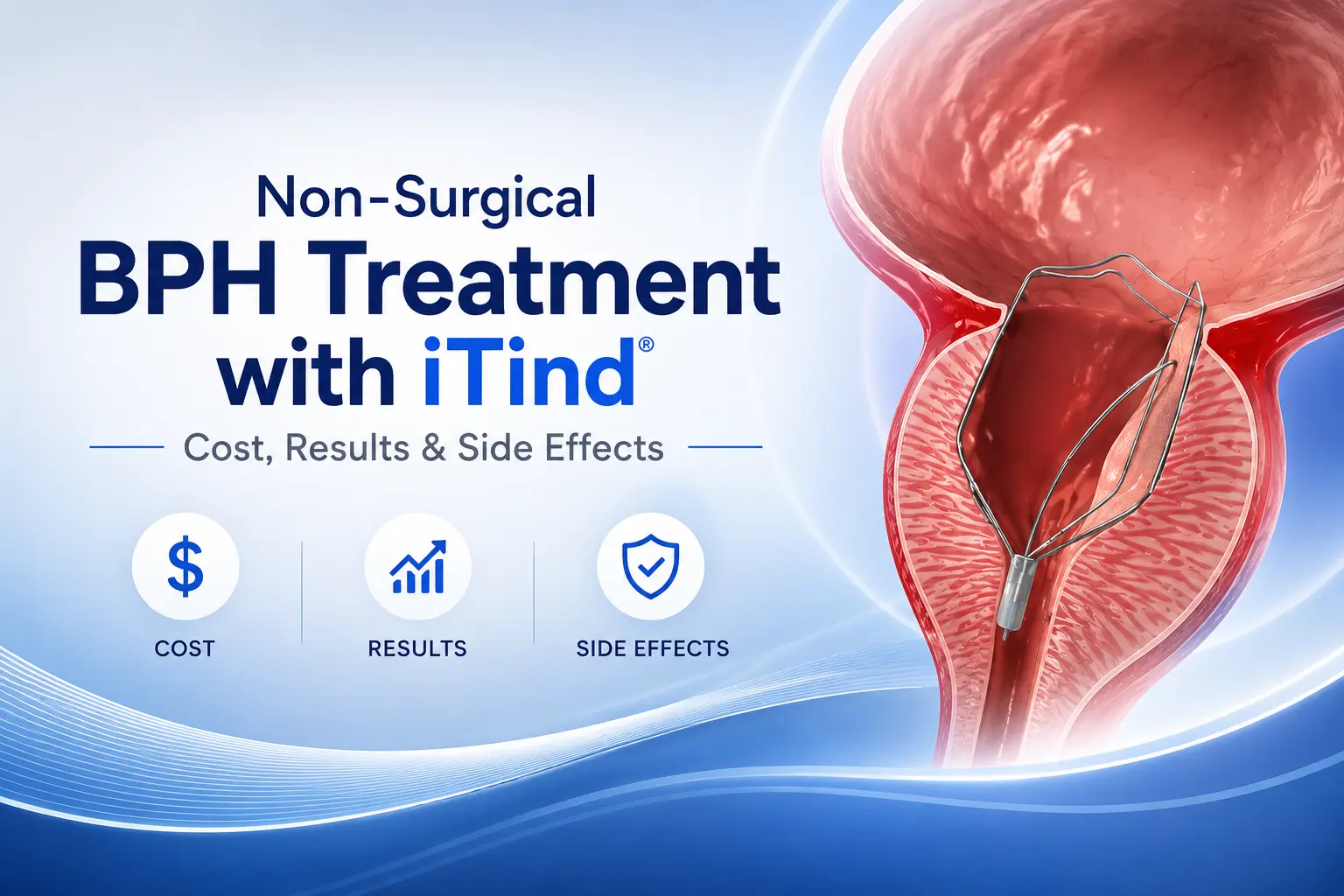
The iTind procedure is a non-surgical treatment for an enlarged prostate (BPH) where a small temporary device is placed inside the prostate for 5 to 7 days to gently reshape it and improve urine flow, after which it is removed. In India, iTind typically costs around ₹1,50,000 to ₹3,00,000, leaves no permanent implant, needs no catheter in most cases, and has shown no sexual side effects in clinical trials.
Key Takeaways
- iTind stands for Temporary Implanted Nitinol Device. It reshapes the prostate without cutting or burning.
- The device is removed after 5 to 7 days. Nothing stays inside the body permanently.
- The procedure is done in a clinic or day-care setting, mostly under local anaesthesia or light sedation.
- No catheter is needed for most patients after the procedure.
- Clinical data show results lasting up to 6.6 years for symptom relief and urinary flow.
- No new sexual dysfunction was recorded in clinical trials, including no erectile dysfunction or retrograde ejaculation.
- In India, the iTind procedure usually costs around ₹1,50,000 to ₹3,00,000, depending on prostate size and clinic.
- iTind is performed in Delhi by Dr. Ashish Saini (MCh Urology, AIIMS) at Excel Advanced Urology Centre, Greater Kailash.
- Global urology guidelines (AUA) recognise iTind as a temporary implant option for BPH.
- iTind suits men aged 50 and above with small to medium prostates who want BPH treatment without surgery.
You wake up three times a night. The urine stream is weak. The urge hits without warning. Medicines helped at first, then they stopped working. Surgery feels like too much, too soon.
This is where the iTind procedure fits in. It is a minimally invasive BPH treatment designed to sit between daily tablets and the operating table. No cutting. No permanent implant. No long hospital stay.
This study explains how the iTind device works, who it suits, what it costs in India, the recovery timeline, side effects, and long-term results, so you can decide with clarity.
What is the iTind Device and How Does It Work?

The iTind is a temporary device made from nitinol, a nickel-titanium alloy that is body-safe and holds its shape at body temperature. Think of it as a small spring-loaded scaffold placed exactly where the blockage is.
A urologist places the device inside the prostatic urethra using a thin telescope called a cystoscope. Once inside, it gently expands in three directions. This expansion creates small channels in the prostate tissue and widens the urine passage.
The device stays in place for 5 to 7 days. During this time, it reshapes the prostate opening. After that, it is removed completely. No tissue is cut, no laser is used, and nothing is left behind. It works like placing a temporary support inside a narrowed pipe so the passage slowly opens and stays open.
The iTind Procedure Step by Step
The process is simple and usually completed as a day-care procedure.
- Assessment: The doctor evaluates your symptoms, prostate size, and urine flow. Tests such as ultrasound and uroflowmetry may be done.
- Placement visit: Under local anaesthesia or light sedation, the iTind is guided into the prostatic urethra through a cystoscope. This takes around 10 to 15 minutes. You go home the same day.
- Days 1 to 7 at home: The device gradually reshapes the prostate. Mild urgency or light discomfort can be managed with simple pain relievers.
- Removal visit: A short outpatient visit. The device is removed. No stitches are involved.
- After removal: Urine flow often starts improving immediately and continues to build over the following weeks.
How Much Does the iTind Procedure Cost in India?
The iTind procedure cost in India generally ranges from around ₹1,50,000 to ₹3,00,000. The final figure depends on prostate size, the number of clinic visits, anaesthesia, diagnostic tests, and the treating centre.
(Note for the clinic: confirm and insert your exact iTind price range here. The figure above is indicative.)
At Excel Advanced Urology Centre in Delhi, Dr. Ashish Saini's team provides a personalised estimate after consultation, so you know the full cost before you decide. Here is how the total is usually built up:
Because the cost varies from patient to patient, the most reliable way to know your exact figure is a consultation.
Is iTind Covered by Insurance in India?
Coverage depends on your individual policy and insurer. Some health insurance plans in India cover minimally invasive BPH procedures when they are medically necessary, while others may treat newer device-based procedures differently.
Many insurers ask for proof that medicines were tried first, along with test results confirming urinary obstruction. The simplest step is to share your policy details with the clinic's team, who can guide you on documentation and what to expect before scheduling.
iTind Success Rate and How Long Results Last
Clinical studies show that iTind delivers durable relief for many men. Long-term data report sustained improvement in urinary flow and symptom scores for up to 6.6 years after the procedure.
Most patients notice stronger flow, fewer nighttime bathroom trips, and better bladder emptying. Because iTind does not remove tissue, it preserves normal prostate function while still opening the passage. For many men, that balance of effectiveness and preservation is the deciding factor.
It helps to remember that BPH is a progressive condition. The prostate can continue to grow with age, so a small number of patients may need further treatment later.
iTind Side Effects

Every procedure carries some risk, and iTind is generally very safe. Most effects are mild and temporary, appearing mainly during the 5 to 7-day treatment window.
Common and temporary effects include frequent urination, urinary urgency, a mild burning sensation, and light discomfort in the pelvic area. These usually settle within days of device removal as the area heals.
Rare effects include a urinary tract infection or short-term difficulty passing urine. Importantly, clinical trials recorded no new cases of erectile dysfunction and no retrograde ejaculation, which makes iTind attractive for men who want to protect their sexual function.
iTind Recovery Timeline
Recovery is usually faster than surgical options because no tissue is cut or removed.
- First week: This is the adjustment phase while the device is in place. Mild urgency or burning may occur and is manageable at home.
- After removal: Urine flow improves, and symptoms begin to reduce. Many patients resume routine work within a few days.
- Following weeks: Flow continues to strengthen and bladder emptying improves further.
Recovery feels a bit like getting used to new footwear. Slightly uncomfortable at first, then natural.
Who is a Good Candidate?
iTind works best in selected cases. It is generally suited to men aged 50 and above with small to medium prostates who have bothersome urinary symptoms and want to avoid surgery, or who are not ready for it.
It is often a strong choice for men who want to preserve sexual function and avoid a permanent implant. It may not be suitable for very large prostates, severe obstruction, or active infection. Choosing the right treatment is like choosing the right shoe size. One size never fits all, which is why a proper urology assessment matters.
What Do the Clinical Results Show?
iTind is backed by peer-reviewed, published data:
- Significant IPSS (International Prostate Symptom Score) reductions in multicenter randomized trials.
- Consistent BPH urinary flow improvement in maximum urine flow rate (Qmax).
- Symptom relief lasting up to 6.6 years in clinical follow-up data.
- Fewer than 5% of patients needed a catheter. True BPH without catheter recovery.
- No new sexual dysfunction across all iTind clinical studies.
The 2023 AUA guidelines formally include iTind under Temporary Implanted Prostatic Devices (TIPD), a recognized BPH minimally invasive surgical therapy (MIST).
What Are Lower Urinary Tract Symptoms (LUTS)?
Lower urinary tract symptoms (LUTS) are the everyday signs that your prostate is pressing on your urethra. In men over 50, LUTS are most commonly caused by BPH. Left unmanaged, they quietly chip away at sleep, confidence, and daily comfort.
LUTS fall into two categories:
Storage Symptoms (how your bladder holds urine):
- Frequency - needing to urinate more than 8 times a day
- Urgency - a sudden, strong urge that is hard to hold back
- Nocturia - waking two or more times at night to urinate
- Urge incontinence - leaking urine before reaching the bathroom
Voiding Symptoms (how your bladder empties urine):
- Weak stream - urine trickles rather than flows steadily
- Hesitancy - difficulty starting urination even when the urge is strong
- Straining - needing to push or bear down to urinate
- Intermittency - urine flow that stops and starts mid-stream
- Incomplete emptying - feeling the bladder is never fully empty
- Terminal dribble - a slow drip at the end of urination
Why LUTS Matter Beyond Inconvenience
Most men dismiss these symptoms as normal aging. They are common. But they are not something you simply have to live with.
Untreated LUTS can lead to urinary tract infections, bladder damage, and in severe cases, complete urinary retention. Broken sleep, social anxiety, and avoiding activities all affect quality of life significantly.
LUTS severity is measured using the International Prostate Symptom Score (IPSS), a standard questionnaire your urologist uses to guide treatment decisions.
iTind vs UroLift vs Rezum vs TURP

There are several BPH treatment options, each with its own role depending on prostate size, severity, and patient preference. The table below compares the main minimally invasive options with TURP, the traditional gold standard.
In short, UroLift uses permanent implants to hold the prostate lobes open, Rezum uses water vapour to shrink tissue, and TURP removes tissue surgically. iTind reshapes the passage temporarily and leaves nothing behind. For a detailed head-to-head, see our guide on iTind vs TURP.
Sexual Function Preservation: What the Studies Say
For many men, sexual function preservation in BPH treatment is the deciding factor, not just a nice feature.
TURP carries a well-documented retrograde ejaculation risk. Heat-based procedures like Rezum carry some risk, too. iTind uses only mechanical pressure, no heat, no cutting.
Published studies tracked de novo sexual dysfunction after iTind. Result: no new erectile dysfunction or retrograde ejaculation recorded. For men weighing BPH minimally invasive surgical therapy (MIST) options, iTind is one of the safest choices for sexual health.
Why Choose Dr. Ashish Saini for iTind in Delhi
Dr. Ashish Saini is a urologist and andrologist with an MCh in Urology from AIIMS New Delhi, MBBS and MS from KGMU Lucknow, more than 15 years of experience, and over 21,000 surgeries performed. He offers the full range of BPH treatments, from iTind and UroLift to laser procedures and TURP, which means your treatment is chosen around your anatomy and goals, not around a single device.
The iTind procedure in Delhi is performed at Excel Advanced Urology Centre in Greater Kailash 1, with personalised assessment and clear, upfront guidance on cost and recovery. You can learn more about the doctor or explore the full prostate (BPH) treatment options.
Conclusion
BPH does not have to mean tablets that stop working or surgery you are not ready for. The iTind procedure is guideline-recognised and clinically proven, built around what matters most: no permanent implant, no catheter in most cases, no sexual side effects, and same-day discharge.
In India, iTind is now available in Delhi NCR through specialist centres like Excel Advanced Urology Centre, making non-surgical BPH treatment more accessible than before. No single treatment fits every man, so the right next step is a proper evaluation. If weak flow, frequent urination, or broken sleep are affecting your life, book a consultation to find an option built around your body.